Well & Rural Plumbing Kendalia TX

Living on a Well in Kendalia: What Keeps the Water Running on Rural Land

Kendalia is ranch country. A few hundred people, a scatter of large tracts along Farm to Market 473 in northeastern Kendall County, and the 1903 Kendalia Halle dance hall still standing where it always has. What Kendalia does not have is a network of city water mains. Out here, no utility pipes water to the house. Every home and ranch pulls its own water from a well and sends its waste to a septic field. When a city dweller loses water, they call the water company. In Kendalia, the homeowner is the water company, and that single fact changes what plumbing means on rural land. The comfort of a place like this depends on a few systems most people never have to think about.

No city utilities, and that is the point

Kendalia is unincorporated, which means there is no municipal water or sewer system reaching most of the community. Properties sit on acreage, served by Blanco schools to the north and bordered by places like Sisterdale and the Guadalupe headwaters country. A home here runs on three systems the owner controls entirely: a private well for water, a septic system for waste, and often propane for gas. The independence is part of the appeal. There is no monthly water bill and no city meter reading each month. The trade is responsibility. Every part of the water system belongs to the property, and when something fails, there is no main down the street to carry the house until it is fixed. Understanding that system is the first step to living comfortably on a well in Kendalia.

A community on its own water

Kendalia is an unincorporated community of a few hundred people in northeastern Kendall County, with no municipal water or sewer lines. Nearly every home and ranch runs on a private well and a septic system.

Ranch country since the 1840s

Kendalia traces its name to George Wilkins Kendall, who brought sheep ranching to the area in the 1840s, and the historic 1903 Kendalia Halle dance hall still stands at its center. The large acreage that defines the area means long water lines between the well and the house.

Hard water from the Trinity

Like most of the Hill Country, Kendalia draws its groundwater from the Trinity Aquifer, which yields hard, calcium-rich water that varies from one well to the next. That hardness scales water heaters and fixtures unless it is treated at the property.

The well system is the heart of the property

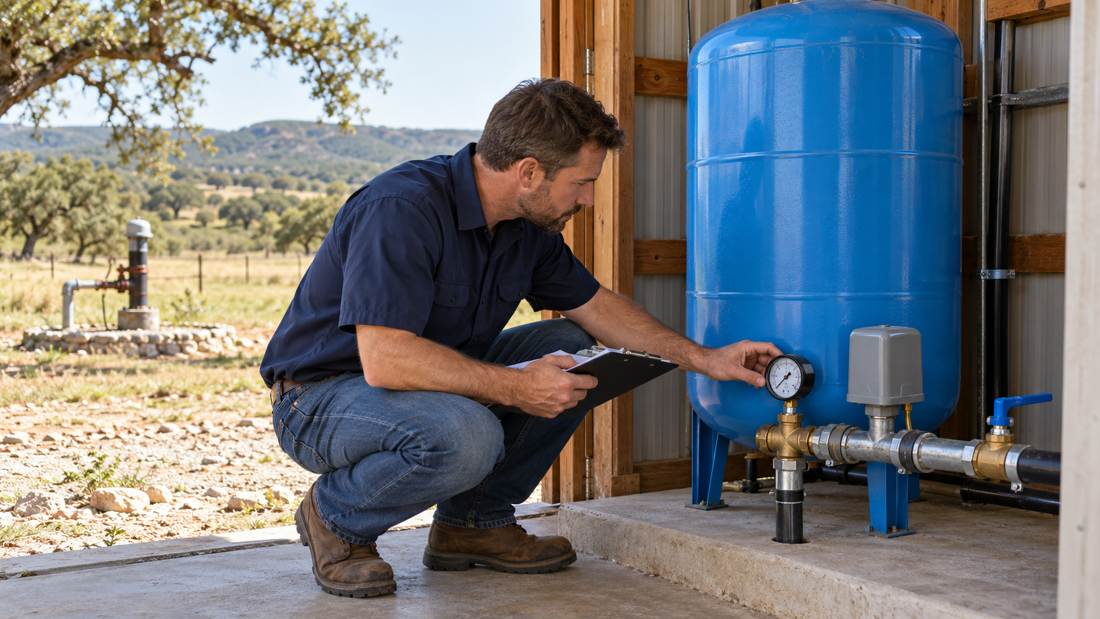
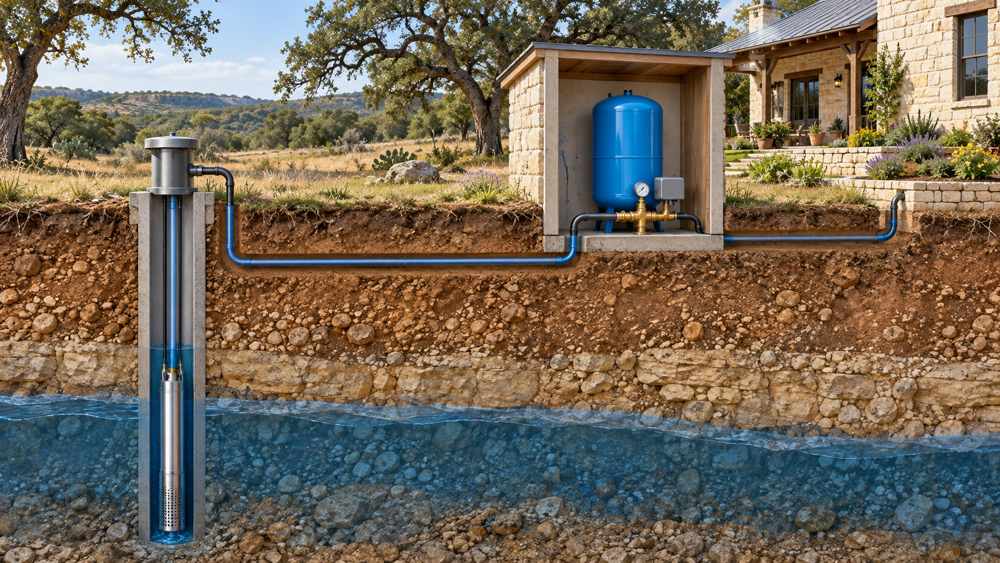
A rural water supply comes down to three parts working together. A submersible pump sits deep in the well and pushes water to the surface. A pressure tank near the house stores that water and holds it under pressure so the faucets have force behind them. A pressure switch reads the pressure and tells the pump when to kick on and off. When all three are healthy, water simply works and the system fades into the background. When any one of them fails, the whole house can lose water at once. That is the part city water customers never have to consider and well owners cannot afford to ignore. On a Kendalia ranch, the well system is not an appliance. It is the lifeline for the house, and often for livestock, gardens, and outbuildings as well.

When the pump quits, the ranch goes dry

A submersible well pump often lasts 8 to 15 years, though hard water and heavy demand can cut that short. It rarely dies without warning. Water pressure that surges and fades, a pump that clicks on and off rapidly, sputtering and air at the faucet, or a slow drop in flow all point to trouble. That rapid on-and-off cycling is especially hard on the equipment, because it burns out the pump motor and the pressure switch faster than steady running ever would. A pressure tank that has lost its air charge, what plumbers call waterlogged, causes the same symptoms and is often mistaken for a bad pump. Telling the pump, the tank, the switch, and the wiring apart is what gets the water back on correctly, rather than throwing a new pump at a problem the tank was causing. On a remote property with no backup, that diagnosis is worth getting right the first time.

Pressure and distance on big acreage

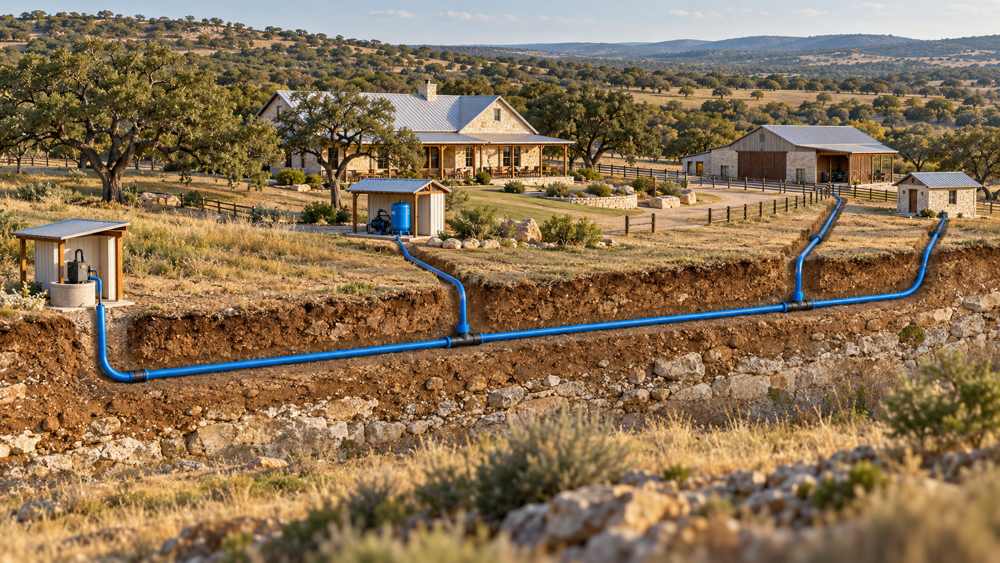
Kendalia properties are large, and that geography shows up in the plumbing. The well, the house, the barn, and the outbuildings can sit a long way apart, which means water travels through long buried lines to reach the far corners of the property. Distance costs pressure, so a fixture at the far end of a ranch can run weak even when the well itself is strong. Proper line sizing, pressure regulation, and sometimes a booster keep pressure even across the whole place. Long underground runs also make leaks harder to find, since a break can lose water for weeks before anyone notices a wet patch or a pump that runs far more than it used to. The larger the property, the more plumbing there is between the well and the last faucet, and the more it helps to work with someone who understands rural distribution rather than only the fixtures inside the house.

Hard Trinity water, out here too

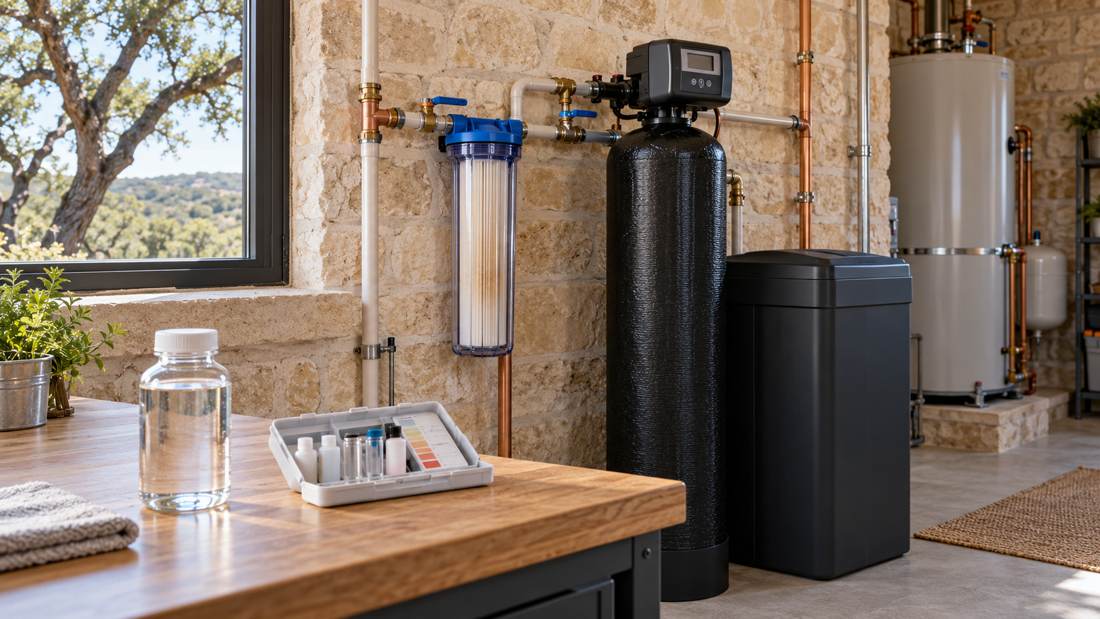
Kendalia draws its groundwater from the Trinity Aquifer, the same limestone source that feeds much of the Hill Country, and that water comes up hard. It carries calcium and magnesium that scale water heaters, crust fixtures, and shorten the life of appliances, and the exact makeup varies from one well to the next. Some Kendalia wells also carry sediment or a trace of iron that stains sinks and laundry. The right response starts with a water test that measures hardness, iron, sediment, pH, and bacteria, because no two wells read the same. From there, a properly sized water softener handles the hardness, a sediment pre-filter catches the grit, and an iron filter goes in when the test calls for it. Treating the water protects the water heater and the plumbing at the same time, which is the kind of well water and whole-property work Gottfried Plumbing handles across Kendalia and northern Kendall County.

Septic, drains, and no sewer line

With no city sewer, every Kendalia home relies on a septic system, and that changes how the drains should be treated. What goes down the drain matters more when it ends up in a tank and a drain field on the property rather than a municipal plant miles away. Grease, wipes, and harsh chemicals that a city system might shrug off can foul a septic system and shorten its life. Rural drain lines also run long distances to the tank and can take on root intrusion over the years, which a sewer camera inspection can find before it turns into a backup. Keeping the drains clear and the line to the tank healthy protects the septic system, and the same plumber who services the well is usually the one who handles the drains. On rural land, the water coming in and the waste going out are two halves of one system.

Winter is the quiet threat

The Hill Country does not freeze often, but when it does it hits hard, as the February 2021 freeze reminded every property owner in the region. Rural well equipment is exposed in ways city plumbing is not. Pressure tanks in unheated pump houses, well heads above the ground, long shallow lines, and outdoor spigots all sit out in the cold, often far from the house and from quick attention. A line that bursts on a remote corner of a Kendalia ranch can run undetected and waste an enormous amount of water before anyone finds it. Insulating the pump house and pressure tank, protecting exposed lines with insulation or heat tape, and draining what can be drained before a hard freeze are all worth doing ahead of time. Winterizing a rural property costs far less than repairing a burst line and cleaning up the water damage that follows it.

Why a plumber who will drive out matters

Not every plumbing company will drive to a community of a few hundred people well off the highway. Distance is real, and a Kendalia property owner learns quickly which companies actually cover northern Kendall County and which stop at the Boerne city limits. A dead well pump or a burst pipe on rural land is an emergency precisely because there is no city water to fall back on, so availability and willingness to make the drive matter as much as skill. The right fit is a licensed plumber who serves Kendalia, Sisterdale, Waring, and Comfort as a matter of course, and who answers the phone when the water goes out at an inconvenient hour.

Where Kendalia turns for well and rural plumbing

Gottfried Plumbing LLC works rural Kendall County from its Boerne shop at 607 E Blanco Road, in the same county as Kendalia and a short drive south. The work covers the whole rural picture: well pump and pressure tank service, water pressure diagnosis across long property runs, water testing with softener and filtration to tame hard Trinity water, water heater repair and replacement across Navien, Rinnai, Rheem, and the major tank brands, drain cleaning and sewer camera inspection on septic lines, and freeze protection before winter. As a Texas State Board of Plumbing Examiners licensed contractor on a 24 hour a day, 7 day a week schedule, it handles the no-water emergencies that leave a rural property without a backup, along with the planned work that keeps a well system reliable. Kendalia homeowners can call (830) 331-2055 for a free estimate.

Redirect to:


A submersible well pump often lasts 8 to 15 years, though hard water and heavy use can shorten that. Warning signs include water pressure that surges and drops, the pump switching on and off rapidly, sputtering or air at the faucet, or a sudden drop in flow. Catching those early is cheaper than waiting for the pump to quit and leave the property with no water.
 

Most do. Kendalia sits over the Trinity Aquifer, so well water tends to be hard and can carry sediment or iron, which scales water heaters and stains fixtures. A water test sets the hardness, iron, and sediment levels, and from there a softener, a sediment pre-filter, and sometimes an iron filter handle it. Every Kendalia well reads a little differently, so the test comes first.
 

On a rural Kendalia property, no water usually points to the well pump, the pressure tank, or the pressure switch rather than the well running dry. A failed or short-cycling pump is the most common cause, and a waterlogged pressure tank is close behind. Because there is no city main to fall back on, a proper diagnosis of the pump, tank, switch, and wiring is what gets the water back.
 

Check our other pages :